Death, the Tower, and the Devil: Understanding Tarot’s Most Intimidating Cards
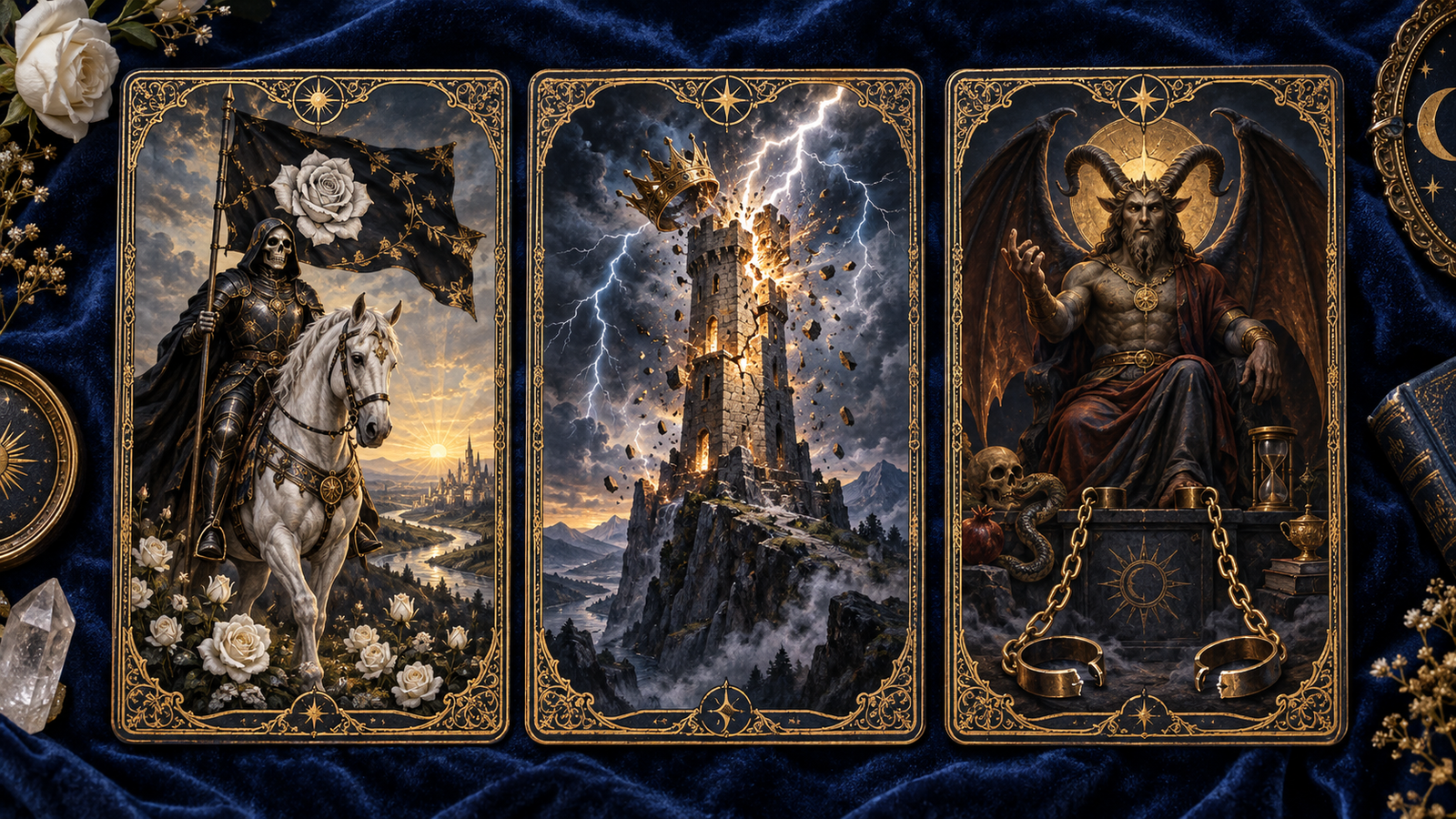
Some cards change the mood of a reading before we even interpret them. An armoured skeleton, a tower struck by lightning, a horned figure with chains—these images can feel unsettling, especially when you are new to tarot.
But a card’s title is only the beginning of its interpretation. Death, the Tower, and the Devil offer different themes to explore: endings, the collapse of familiar assumptions, and attachments that limit freedom.
This article follows common modern interpretations of the Rider–Waite–Smith tradition. Other decks may use different imagery or emphasise different meanings.
Start with the question
Imagine asking, “What would help me finish my creative project?” and drawing Death.
The title alone might alarm you. In the context of your question, however, the card could invite you to stop endless revisions, retire an outdated idea, or acknowledge that it is time to release the finished work.
In a position called “What is getting in the way?”, the same card could prompt reflection on difficulty letting go of an old approach.
Before interpreting it, ask:
- What question did I ask?
- What does this position explore?
- What is actually happening in my situation?
- How do the surrounding cards contribute to the theme?
Cards are not evidence of a coming disaster, another person’s intentions, or a hidden threat.
🥀 Death: when a chapter comes to an end
Death’s central themes include endings, transition, letting go, and changes to a familiar way of life.
The card invites attention to something that is ending or can no longer continue in its current form. Sometimes this concerns a visible event. Sometimes it is a quieter recognition: an old plan no longer fits, a role has become restrictive, or your interest has changed.
Drawing the card does not justify predicting a physical death.
What this might look like in everyday life
You have spent months trying to revive a project that no longer matches your goals. You continue out of loyalty to the time already invested, although you would rather pursue something else.
Death might offer the question: “What am I trying to preserve simply because it used to matter?”
An ending does not have to feel immediately liberating. You can recognise the need for change while still grieving what you are leaving behind.
Questions to explore
- What has already reached its conclusion?
- What am I finding difficult to release?
- What would I like to preserve from this experience?
- How could I mark the ending thoughtfully?
The central idea: acknowledging an ending can mean allowing the past to stop asking for more of your time.
⚡ The Tower: when a familiar structure fails
The Tower is often associated with upheaval, sudden revelation, and the collapse of something that appeared secure.
Where Death invites reflection on an ending, the Tower draws attention to the moment when an old explanation no longer holds.
This may involve an unexpected change. It may also involve something that has been evident for a while but can no longer be ignored.
What this might look like in everyday life
You assumed everyone working on a shared project understood its purpose in the same way. An honest conversation reveals that each person has been working towards a different outcome.
That discovery is uncomfortable, but it makes the real problem visible. The next step is to revisit your agreements instead of continuing on untested assumptions.
The Tower does not instruct you to destroy a relationship, resign, or make an impulsive decision. Its imagery can prompt you to examine what supports your conclusions.
Questions to explore
- Which assumption have I been treating as a fact?
- What has become clear?
- What is genuinely stable here?
- What needs reconsidering before I move forward?
The central idea: when a familiar picture breaks apart, distinguish the loss of a comforting explanation from the practical consequences.
⛓️ The Devil: what is keeping me attached?
The Devil is often interpreted through attachment, temptation, control, excess, and a sense of restricted freedom.
This reading focuses on a relationship with something that is compelling but also narrows your choices. It could involve seeking approval, trying to control every detail, or repeating an unsatisfying activity for a brief reward.
Drawing the Devil does not confirm a curse, an evil presence, or that another person is inherently bad.
What this might look like in everyday life
You share a piece of work and spend the evening refreshing the page to check reactions. Gradually, the pleasure of creating gives way to waiting for other people’s approval.
The card might prompt the question: “When did receiving reassurance become more important to me than doing something I enjoy?”
However, not every restrictive situation can be changed through a single decision. Real obligations, pressure, and dependence on circumstances deserve attention and support. The image of chains should never become an accusation that someone is to blame for being unable to leave.
Questions to explore
- What am I getting from this attachment?
- What is it costing me?
- Where do I genuinely have a choice?
- What small step or support could expand that choice?
The central idea: notice both the appeal of a pattern and its price.
How the three cards differ
| Card | Central theme | A question to explore |
|---|---|---|
| Death | Ending and transition | What is ready to end? |
| The Tower | Upheaval and reconsidering foundations | What no longer stands up to examination? |
| The Devil | Attachment and restricted choice | What holds me here, and at what cost? |
All three could relate to one situation while illuminating different aspects of it.
In a stalled project, for example, the Devil could symbolise attachment to recognition, the Tower the discovery that a plan is unworkable, and Death the decision to retire the project’s previous form.
This is an example of a connected interpretation, not an inevitable story attached to the combination.
What if the card is reversed?
If you use reversals, choose a clear approach to interpreting them. A reversed card does not have to mean the opposite of its upright meaning or make its difficult themes worse.
Some approaches use reversals to explore resistance, an inward expression of the theme, or a developing change.
For example:
- Death: difficulty acknowledging an ending.
- The Tower: trying to preserve an assumption you already doubt.
- The Devil: beginning to recognise an attachment or looking for a way to loosen it.
These are possible directions for interpretation. The question’s context remains more important than a fixed formula.
What to do if a reading frightens you
Give yourself a pause. You do not need to keep drawing cards until you receive a reassuring answer.
First, describe the result neutrally: “I drew the Tower in the obstacle position.” Then separate the image from your conclusion: “I felt frightened” does not mean “something terrible must happen.”
Return to your question and identify one theme you can explore without making a rushed decision. If that feels difficult, you can put the reading aside.
Challenging cards do not have to become cheerful messages. They can raise themes of loss, disappointment, or restriction. But a useful interpretation leaves space for understanding and action, rather than taking away your choices.
Which of these three cards initially intimidated you most? Has your relationship with it changed over time?
Написал(а) Kistamets